
 USD
 EUR
 AUD
 GBP
 JPY
 INR
 MXN
 CAD
 JMD
Total: $0.00
Taxes and shipping calculated at checkout


A tea tree oil spot treatment for blemishes should be diluted before it touches your skin; don’t apply undiluted oil directly to your face. For a homemade dilution, use about 12 drops of carrier oil for every one to two drops of tea tree oil, and patch test before use. Natural doesn’t always mean gentle.
Tea tree oil may help with active acne, but that doesn’t mean it will fade the marks blemishes leave behind. It can also irritate or dry your skin, so how you use it matters as much as the ingredient itself. Learn how to apply it carefully, what to know about its potential for post-acne marks, and how to assess skincare products containing tea tree oil. A thoughtful routine starts with clear information, a light touch, and attention to how your skin responds.
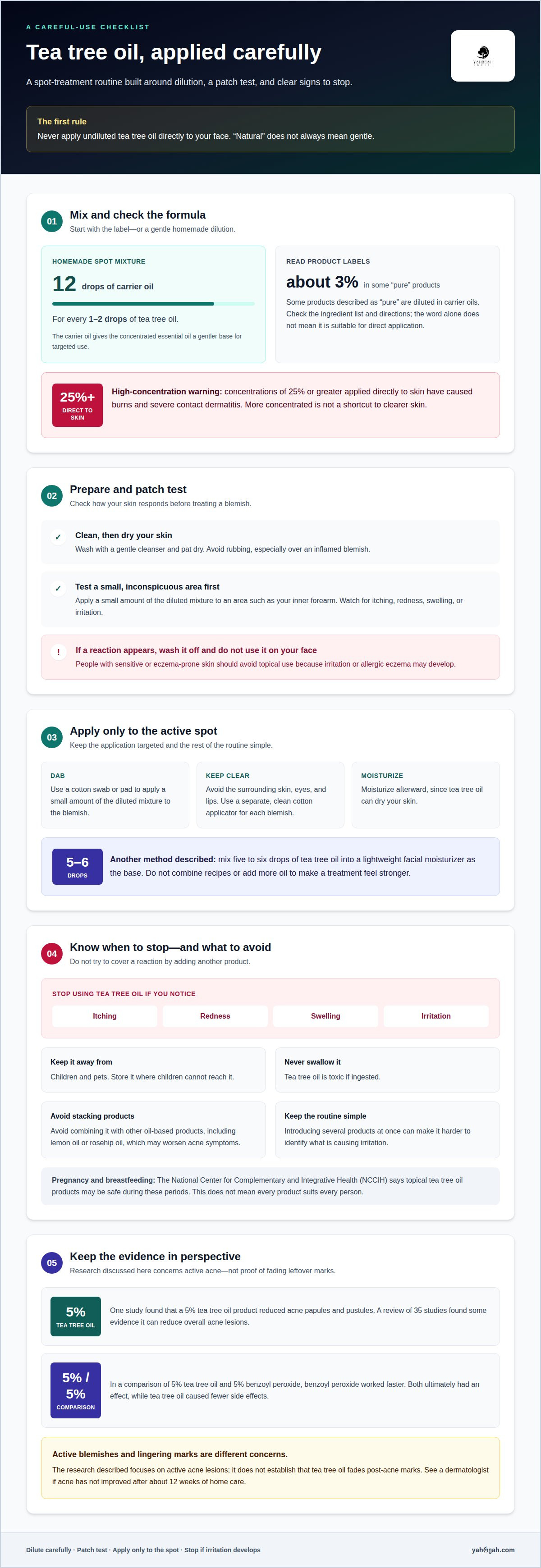
Tea tree oil is a concentrated essential oil, so dilution matters before it touches facial skin. For a simple homemade mixture, combine about 12 drops of carrier oil with one to two drops of tea tree oil. This ratio gives the essential oil a gentler base for targeted use. Never apply undiluted tea tree oil directly to the face.
Some products described as “pure” tea tree oil are diluted in carrier oils to about 3%. Read the ingredient list and directions rather than assuming “pure” means suitable for direct application. Concentrations of 25% or greater applied directly to skin have caused burns and severe contact dermatitis. A more concentrated mixture isn’t a shortcut to clearer skin.
Before using a new mixture, patch test it on a small area, such as your inner forearm. If itching, redness, swelling, or irritation appears, stop using it. To apply it to a blemish, use a cotton swab or pad to dab a small amount of the diluted mixture onto the spot. Keep it off the surrounding skin and away from your eyes. Moisturize afterward, since tea tree oil can dry your skin.
Use a separate, clean cotton applicator for each blemish instead of dipping a used swab back into the mixture. This helps keep the remaining blend clean. One method uses a facial moisturizer as the base, mixing five to six drops of tea tree oil into a lightweight moisturizer. Don’t combine recipes or add more oil to make the treatment feel stronger.
The National Center for Complementary and Integrative Health (NCCIH) says topical tea tree oil products may be safe during pregnancy and while breastfeeding. Keep the oil away from children and pets, and never swallow it, as tea tree oil is toxic if ingested.
See a dermatologist if acne hasn’t improved after about 12 weeks of home care. Tea tree oil research focuses on active acne lesions, so it doesn’t establish that the ingredient fades post-acne marks. Marks left after blemishes call for a different consideration than treatments intended for current pimples.
Studies have examined several concentrations. One study found that a 5% tea tree oil product reduced acne papules and pustules. A review of 35 studies found some evidence that tea tree oil can reduce overall acne lesions. In a comparison of 5% tea tree oil and 5% benzoyl peroxide, benzoyl peroxide worked faster; both treatments ultimately had an effect, while tea tree oil caused fewer side effects. These findings concern acne, not proof of fading leftover marks.
A tea tree oil spot treatment for blemishes is intended for active spots; evidence about acne lesions shouldn’t be taken as proof that it fades marks. Benzoyl peroxide is another acne ingredient studied in direct comparison with tea tree oil. The findings suggest trade-offs in speed and side effects, rather than one option being best for everyone. A gentle cleanser and moisturizer can support a simple routine. Introducing several products at once can make it harder to identify what’s causing irritation.
Before choosing a tea tree oil spot treatment for blemishes, decide whether active acne or lingering marks are your main concern. Keep the rest of your routine simple while testing a product. Avoid combining tea tree oil with other oil-based products, including lemon oil or rosehip oil, since they may worsen acne symptoms. Don’t layer several new acne ingredients onto the same blemish without a clear reason. If a product irritates your skin, stop using it rather than adding more products to counter the reaction.
A careful routine starts before tea tree oil reaches a blemish. Clean skin, a small patch test, and attention to irritation can help you make an informed choice.
Prepare your skin by washing with a gentle cleanser, then drying your face before applying tea tree oil. Clean, dry skin gives the diluted product a clear target and avoids trapping makeup or surface residue underneath it. Pat gently rather than rubbing, especially over an inflamed blemish. Apply only to the spot, keeping the mixture away from your eyes and lips.
A patch test involves applying a small amount of the diluted mixture to an inconspicuous area, such as your inner forearm, before using it on your face. This can reveal sensitivity before the product reaches more visible skin. Watch the test area for itching, redness, swelling, or irritation. If a reaction appears, wash it off and don’t use tea tree oil on your face.
Tea tree oil can cause skin irritation or allergic contact dermatitis, including an itchy rash. People with sensitive or eczema-prone skin are advised to avoid it because irritation or allergic eczema may develop. Stop applying the oil immediately if itching, redness, irritation, or swelling appears where you used it. Don’t try to cover a reaction by adding moisturizer or another acne ingredient.
Keep tea tree oil away from children and store it where they can’t reach it. People with sensitive or eczema-prone skin should avoid topical use because of the risk of irritation and allergic eczema. Pregnancy and breastfeeding aren’t automatic reasons to avoid every topical product: the National Center for Complementary and Integrative Health (NCCIH) says topical tea tree oil products may be safe during these periods. That guidance doesn’t mean every product suits every person, so don’t assume all formulas are interchangeable.
A finished tea tree oil product can be simpler to use than mixing essential oil at home, but the label still matters. A leave-on spot treatment, cleanser, and moisturizer serve different roles: a product that rinses off isn’t used like one that stays on a blemish. Follow the directions for the specific formula rather than assuming every product has the same strength or use.
Look for tea tree oil in the ingredient list and read the full directions before applying a product to your face. Words such as “natural” or “pure” don’t explain the formula by themselves. Cosmetic products may combine tea tree oil with other ingredients, and product quality and ingredients can vary widely. Tea tree oil isn’t regulated like a medicine, so skincare claims don’t make a product an acne medication.
Concentration can also differ across formulas. The highest concentration reported in a cosmetic product is less than 0.5%; that figure isn’t a target for choosing a treatment. More concentration doesn’t automatically mean better results, and the oil’s properties depend on the finished formula. Use caution with concentrated oils, and don’t add extra tea tree oil to a ready-made product.
Compare products by their intended use, directions, and complete ingredient lists. For example, if a cleanser and spot treatment both contain tea tree oil, using both may increase exposure without clarifying which product suits your routine. Introduce one new product at a time, follow its label, and watch for irritation. A clear label helps you understand what you’re applying, but it can’t establish that a formula will fade post-acne marks.
For a considered routine beyond a single blemish, explore natural skincare options and choose products with ingredients and directions that suit your needs.
Yahreah Skin offers natural skincare products for anyone seeking a thoughtful approach to everyday skin care. Tea tree oil isn’t right for every skin type, so choose products carefully: read the ingredients, follow the directions, and pay attention to your skin’s response. If you’re exploring skincare alongside broader wellness, Yahreah Skin also offers premium supplements, including women’s and men’s health supplements. These offerings address different needs, but they don’t replace dermatologist care for persistent or severe acne. Keep your routine grounded in what a product is designed to do, without expecting skincare to erase post-acne marks. Explore Yahreah Skin’s skincare and supplements online.
Let your skin’s response guide what comes next. A tea tree oil spot treatment for blemishes is only one possible part of skincare, not a reason to push through discomfort or expect one ingredient to address every concern. If acne persists or lingering marks are your main concern, consider what support best fits your needs, including guidance from a dermatologist.
For your everyday routine, choose products thoughtfully and give your skin room to show how it responds. A calm, consistent approach can make skincare feel more intentional, without turning every new blemish into a reason to add another product. If you’d like to discuss skincare options, contact Yahreah Skin.
Your next step can be simple: stay attentive, choose with care, and let your routine evolve at a pace that feels right for you.
Tea tree oil is an essential oil containing more than 100 bioactive compounds. In skincare, it appears in products intended for different uses, including leave-on spot treatments and cleansers. Those formats aren’t interchangeable: a cleanser is rinsed away, while a spot treatment stays on the skin. Read the product’s ingredient list and directions to understand how it’s formulated and intended to be used.
There isn’t an established amount that ensures visible acne improvement. Research has examined products with a 5% tea tree oil concentration, but a study concentration isn’t a recommended dose for every person or product. Check the directions on the specific formula instead of adding extra oil. Visible changes can take time, and the effect on active blemishes shouldn’t be confused with fading post-acne marks.
Some tea tree oil acne routines recommend applying it twice daily, but follow the product’s own directions. A tea tree oil spot treatment for blemishes may have different directions from a cleanser, which is rinsed off. Don’t introduce multiple new acne products at once; changing one product at a time makes it easier to notice how your skin responds.
Tea tree oil may be worth considering for active acne if you can use a suitable product comfortably and follow its directions. The research discussed here focuses on acne lesions, not reliably fading the marks they leave behind. Consider your main concern before choosing a product: a treatment studied for active blemishes may not address lingering discoloration. Persistent acne is a reason to seek a dermatologist’s advice.
Research suggests tea tree oil may reduce active acne lesions, but findings don’t establish it as a treatment for post-acne marks. Studies have examined a 5% concentration, and a review of 35 studies found some evidence of fewer overall acne lesions. In a comparison with 5% benzoyl peroxide, benzoyl peroxide worked faster, while both treatments ultimately had an effect.
For a tea tree oil spot treatment for blemishes, mix one to two drops of tea tree oil with about 12 drops of carrier oil. After cleansing and drying your face, use a clean cotton swab to apply a small amount to the blemish. Keep it away from your eyes, moisturize afterward, and patch test first. Stop using it if irritation, redness, or swelling develops.


