

 USD
 EUR
 AUD
 GBP
 JPY
 INR
 MXN
 CAD
 JMD
Total: $0.00
Taxes and shipping calculated at checkout


A postnatal vitamin isn’t automatically the right next step for every nursing mother. The right postnatal wellness supplements for nursing mothers depend on individual nutritional needs: according to the National Institutes of Health Office of Dietary Supplements, the recommended dietary allowance of calcium when breastfeeding is 1000 mg per day. A supplement may help fill a gap, but it isn’t a substitute for assessing what your diet and existing supplements provide.
It makes sense to want steady support during recovery and breastfeeding while being careful not to take more than you need. The right formulation matters as much as the decision to supplement.
Here, you’ll learn when a postnatal vitamin may be useful, how omega-3s are discussed in relation to postpartum mood, and what to consider when comparing supplement formulations. The goal is a clearer, calmer way to weigh your options, with attention to nutrient amounts and how different formulas are evaluated.
A postnatal vitamin may help address nutrient gaps, but breastfeeding alone doesn’t determine whether you need one. Consider what your prenatal already provides, your diet, and any specific nutritional needs.
Continuing a prenatal while breastfeeding means using a pregnancy-formulated supplement after birth. It may offer familiar nutrient support, but its amounts may not match your needs during lactation. According to the National Institutes of Health, Office of Dietary Supplements, the recommended dietary allowance for lactating mothers is 1000 mg calcium daily. For lactating women ages 19-50, the recommended dietary amount is 9 mg iron daily. For women who are pregnant or lactating, the recommended dietary allowance is 600 IU vitamin D daily. The recommended dietary amounts for lactating women are 290 mcg iodine daily and 500 mcg folate daily. The same office describes maternal vitamin D doses exceeding 4000 IU daily as above the safe upper limit. Compare the prenatal label with your other supplements to avoid overlooking overlapping nutrients.
Postpartum supplement support means choosing nutrients to complement food and breastfeeding, rather than assuming every mother needs the same formula. The amounts on a prenatal label can help frame the decision, but your food intake and current supplements matter too. For example, calcium needs may be met through a mix of foods and supplements. Review the full serving amounts, not just the ingredient list, and consider whether a postnatal formula fits your current routine better. A fatty acid supplement serves a different purpose from a multivitamin, so don’t treat them as interchangeable.
Fenugreek appears in some herbal lactation supplements, but it shouldn’t be treated as a guaranteed way to increase milk supply; safety can depend on medicines and health circumstances. Ask a healthcare professional before using it, as supplement labels advise for nursing mothers. Avoid stacking multiple products with overlapping ingredients, especially prenatal vitamins and multivitamins, without reviewing their combined amounts. Caffeine intake is advised to stay at or below 300 milligrams daily while nursing. After alcohol, wait at least two hours before breastfeeding. These choices support a more considered feeding routine.
Omega-3 fatty acids are essential nutrients, but taking them shouldn’t be treated as a proven way to prevent or relieve postpartum mood concerns. DHA and EPA are long-chain omega-3 fats; their role in nutrition is distinct from mental health care. A multivitamin may contain other ingredients, so read its label to see whether it provides DHA, EPA, or neither.
During pregnancy and postpartum, food is one way to include omega-3s. The Dietary Guidelines for Americans recommend that breastfeeding mothers consume 200-300 milligrams of omega-3 fatty acids daily. They also recommend 1-2 six-ounce servings of fish weekly to maintain appropriate DHA levels in breast milk. The American College of Obstetrics and Gynecology recommends at least two servings of fish or shellfish each week while breastfeeding. These recommendations emphasize seafood as a source of essential fats.
DHA is one specific omega-3 fatty acid, while EPA is another. A supplement listing “DHA+EPA” combines both, but the total omega-3 amount alone doesn’t tell you how much of each it contains. Compare the ingredient panel for separate DHA and EPA amounts, serving size, and other ingredients. The recommended dietary allowance of omega-3 long-chain polyunsaturated fatty acids for breastfeeding women is 200 mg daily.
Seafood choices matter. While breastfeeding, avoid fish with high mercury levels, including bigeye tuna, king mackerel, marlin, shark, swordfish, and tilefish. Choose fish that provides DHA while fitting this guidance, and follow local seafood advisories for locally caught fish. If fish isn’t part of your diet, a DHA or DHA+EPA supplement may be another way to consider omega-3 intake, but its label helps clarify what it supplies.
For postpartum mood concerns, nutrition is only one part of the picture. Omega-3s support dietary intake; they aren’t a substitute for professional care when mood symptoms affect daily life. Consider food patterns, supplement ingredients, and emotional wellbeing together, rather than expecting one fatty acid to address every need.
A useful comparison looks beyond ratings to the label: nutrient amounts, ingredient forms, and whether the formula suits breastfeeding. Consider how its vitamins and minerals overlap with a prenatal or separate supplements. A postnatal formula isn’t essential for every nursing mother; whether it fits depends on dietary intake and individual nutrient needs.
For a practical product comparison, assess each label using the same criteria. Note the amount per serving, serving size, and nutrients that appear in other products you take. Calcium, iron, iodine, and folate can help illustrate how formulas differ. Check whether a product is intended for postpartum use, and distinguish a multivitamin from an omega-3 supplement. These steps clarify what a formula provides without relying on a popularity ranking.
There isn’t a single best-rated postnatal vitamin established by these criteria, and prices vary by product. Compare labels and ratings separately: a high rating doesn’t show whether the nutrient profile matches your needs. Blood loss during delivery may also affect iron needs, so don’t select a formula by rating alone.
Vitamin D deserves separate attention because maternal supplementation and infant supplementation aren’t interchangeable. Breast milk alone doesn’t provide infants with adequate vitamin D, so most need an additional source shortly after birth. The Dietary Guidelines for Americans and the American Academy of Pediatrics recommend 400 IU of vitamin D per day for breastfed and partially breastfed infants, beginning in the first few days of life. Families considering maternal high-dose supplementation instead should discuss its risks and benefits with a healthcare provider.
Postpartum supplements can relate to a baby’s health through nutrient transfer, but infant vitamin D needs specific attention. The supplement label advises nursing mothers to consult a healthcare professional before use, and the manufacturer recommends discussing the baby’s vitamin supplementation with a doctor. This helps keep maternal vitamins, infant needs, and feeding plans distinct.
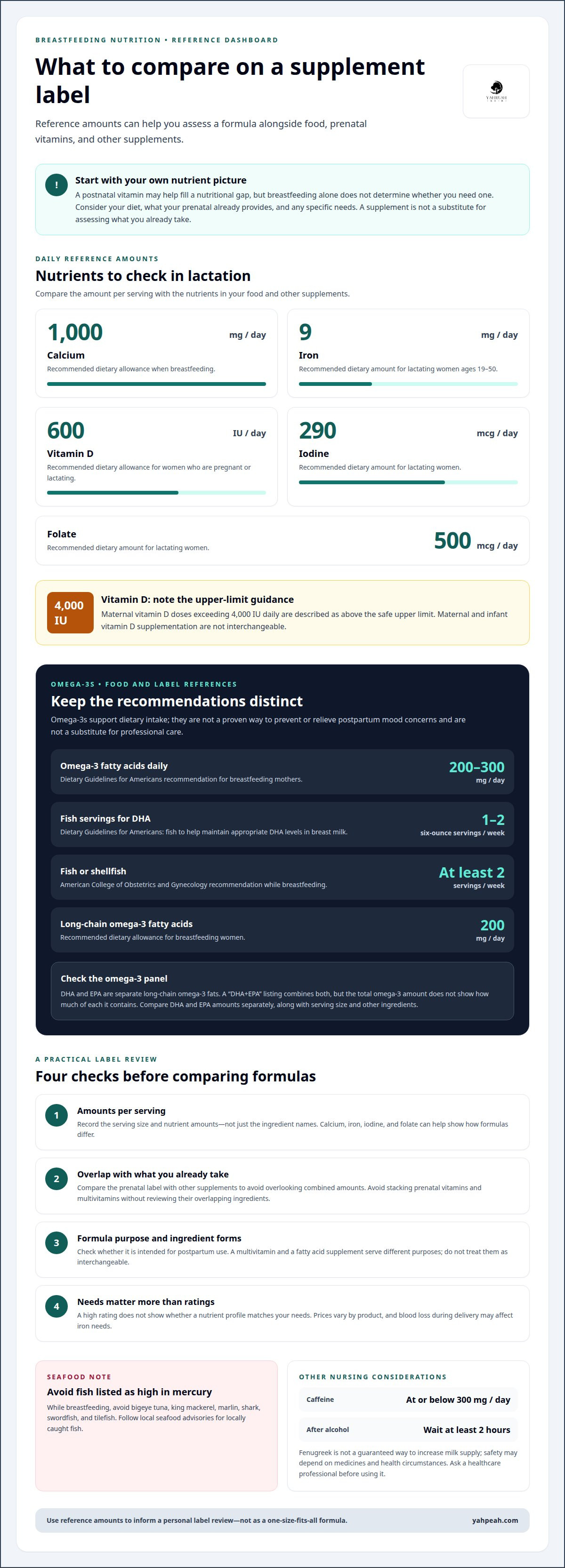
Compare formulas by nutrient amounts and ingredient forms, not by the number of ingredients on the label. A broad multivitamin may combine minerals, vitamins, DHA, and herbs; a focused formula may center on fewer nutrients. During lactation and recovery, consider what each serving provides and whether it overlaps with prenatal vitamins or other supplements.
For nursing mothers, the recommended dietary amount of iodine is 290 mcg daily, according to the National Institutes of Health, Office of Dietary Supplements. Choline recommendations for postpartum and lactating women are 425 to 550 milligrams daily. The recommended dietary allowance of vitamin D for women who are pregnant or lactating is 600 IU daily, according to the National Institutes of Health, Office of Dietary Supplements. The Dietary Guidelines for Americans recommend 200-300 milligrams of omega-3 fatty acids daily for breastfeeding mothers. These amounts provide a useful framework for comparing labels, not a reason to combine products without reviewing total intake.
Formulas can differ in mineral forms and added ingredients. Calcium citrate is recommended over calcium carbonate because it is more easily absorbed. Some postnatal blends include choline, iron, DHA, B vitamins, fenugreek, blessed thistle, and moringa leaf. Others may contain fermented soy. Review the full ingredient panel for these additions, especially if you avoid particular ingredients or already take a prenatal.
Consider the intended role of each formula. A product with DHA targets a different nutrient need than one focused on vitamins and minerals; herbs add another distinct category. Neither a longer ingredient list nor a single nutrient establishes that a formula suits every nursing mother. Breast milk and infant needs also require separate consideration, including vitamin D supplementation for infants.
For a clearer comparison, line up serving size, amounts, ingredient forms, and overlap across products. This makes the formula’s purpose easier to see without assuming it improves cognitive development or postpartum recovery. Explore thoughtful wellness options as you consider what fits your routine.
Yahreah Skin offers women’s health supplements and premium supplements as part of a broader approach to everyday wellness. Nursing mothers comparing formulations can explore these options while keeping individual nutrient needs and existing products in mind. The range also includes men’s health supplements and natural skincare products, supporting a considered personal-care routine beyond the postpartum period.
Choose supplements thoughtfully, paying attention to the ingredients and amounts that suit your needs. If you’d like to learn more about Yahreah Skin’s wellness offerings, contact Yahreah Skin.
Your next step can be simple: identify what you want a supplement to support, then look for a formula that fits your needs and current routine. Choosing postnatal wellness supplements for nursing mothers is a personal decision, not a measure of how well you’re recovering or caring for your baby. Take time to consider what feels appropriate for this stage.
Yahreah Skin offers Women’s Health Supplements, Men’s Health Supplements, and Premium Supplements as part of its broader wellness range. If you have questions as you consider your options, contact Yahreah Skin with your questions. Move forward at your own pace, with care and clarity.
There isn’t one vitamin routine that fits everyone after birth. Your diet, current supplements, and specific nutritional needs all matter. Choosing postnatal wellness supplements for nursing mothers starts with listing what you already take, including prenatal vitamins and single-nutrient products. Then compare labels to spot overlap. A supplement is most useful when it addresses a real gap, rather than adding ingredients simply because they appear in a postpartum formula.
Recommended choices depend on which nutrients your usual diet and existing supplements provide. For example, a mother who rarely eats seafood might consider how she gets omega-3s, while someone using a multivitamin may already have several nutrients covered. Compare the purpose and serving details of each product before adding another. The best postnatal wellness supplements for nursing mothers are those that fit their needs, not simply those with the longest ingredient list.
Pregnancy formulas may be appropriate for some nursing mothers, but they may not match everyone’s postpartum needs. Check the label against any other supplement you take, especially if both products contain overlapping vitamins or minerals. For instance, using a prenatal alongside a separate multivitamin can make the combined intake harder to assess. The formula’s name matters less than its contents and fit with your routine.
Not every breastfeeding mother needs supplemental iron, though postpartum iron supplementation is advised for six to eight weeks after delivery. Whether to consider it depends on blood loss during birth and whether your iron needs are otherwise being met. Don’t assume that a prenatal or postnatal multivitamin provides the amount appropriate for you. Review your supplement label and discuss iron needs in light of your delivery and health history.
Supplements can help address nutrient gaps, but they shouldn’t be treated as a guaranteed remedy for low energy or postpartum hair loss. Research hasn’t established that vitamins prevent hair loss after delivery. Gentle hair care, including limiting heat and styling that may cause thinning or breakage, can be a practical measure. If tiredness or hair changes concern you, consider the wider picture, not only a supplement label.
Read the label and look for clear information about ingredients, serving amounts, and any independent testing. A useful testing statement identifies what was tested, such as ingredient identity or contaminants, and whether testing applies to finished products. Don’t treat a vague “tested” claim as proof of every quality measure. Keep the container or label available when discussing a product alongside medicines or other supplements.


