
 USD
 EUR
 AUD
 GBP
 JPY
 INR
 MXN
 CAD
 JMD
Total: $0.00
Taxes and shipping calculated at checkout


Astaxanthin can complement a thoughtful sun-care routine, but it does not replace sunscreen. An astaxanthin supplement for skin UV defense may offer antioxidant support over time, while topical sunscreen remains essential for blocking UV rays. That distinction matters.
It’s natural to wonder whether this red-orange pigment can help protect skin, affect its color, or make time outdoors feel safer. Astaxanthin occurs naturally in microalgae and some seafood, and human skin studies have generally assessed daily use over 6-12 weeks. This guide explains what the evidence suggests, how it compares with findings on other supplements, and what researchers have studied about skin changes. You’ll also see why an oral supplement isn’t a substitute for topical sun protection, and how formulation and absorption fit into the conversation. The goal is a clear-eyed view of where astaxanthin may belong in a skin-care routine, without asking it to do more than the evidence supports.
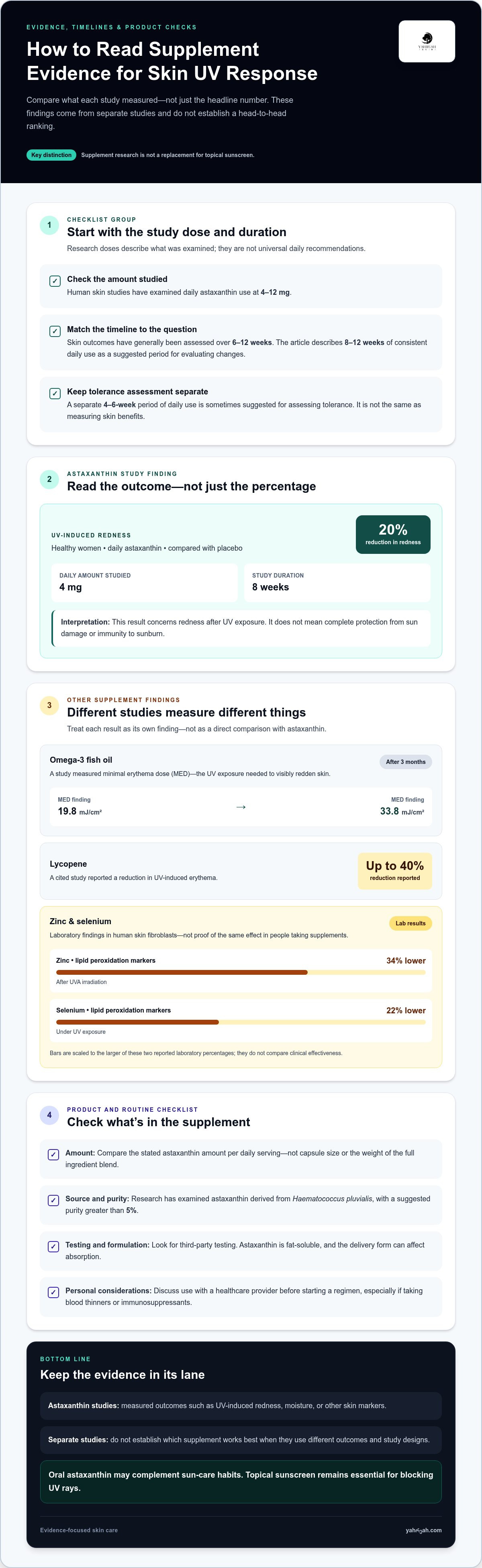
Supplement studies use different doses and timelines, so compare the exact ingredient amount and study duration. Human skin research has assessed daily astaxanthin use over 6-12 weeks. Across clinical studies, adults taking 4-12 mg daily have been studied for potential protection against sun-induced skin damage. These research doses describe what was examined, not a universal daily recommendation.
One photoprotection study found that healthy women taking 4 mg daily for 8 weeks had a 20% reduction in UV-induced redness compared with placebo. That result concerns redness after UV exposure, not complete protection from sun damage. A suggested 8-12 weeks of consistent daily use gives more time to evaluate skin changes. A separate 4-6-week period of daily use is sometimes suggested for assessing tolerance, while reported benefits may begin within 6-12 weeks.
Other supplements have different evidence and outcomes. An omega-3 fish-oil study found the minimal erythema dose rose from 19.8 to 33.8 mJ/cm2 after three months. Minimal erythema dose measures the UV exposure needed to visibly redden skin. A study cited for lycopene reported up to a 40% reduction in UV-induced erythema. These findings don’t establish which supplement works best, because the results come from separate studies, not direct comparisons.
Zinc and selenium research adds another comparison, but at a different level. In human skin fibroblasts, zinc reduced lipid peroxidation markers by 34% after UVA irradiation, while selenium reduced them by 22% under UV exposure. Fibroblast findings are laboratory results, not proof of the same effect in people taking supplements. Collagen and elasticity outcomes also differ from measures of UV-induced redness or skin damage.
For a practical comparison, check the label for the amount of astaxanthin per daily serving, its source, and third-party testing. Research has examined astaxanthin derived from Haematococcus pluvialis, with a suggested purity greater than 5%. Food sources include microalgae and red-hued seafood, but dietary intake isn’t equivalent to a measured supplement dose. This helps distinguish product contents from study doses.
Formulation matters because astaxanthin is fat-soluble, and a supplement’s delivery form can affect absorption. Compare the stated astaxanthin amount rather than capsule size or the weight of the full ingredient blend. Choose third-party-tested supplements, and discuss use with a healthcare provider before starting a regimen, especially if you take blood thinners or immunosuppressants.
An astaxanthin supplement for skin UV defense can be assessed by its stated dose, source, testing, and time used. Keep expectations tied to the measured outcome: studies examine redness, moisture, or other skin markers, not a substitute for sunscreen. Compare those endpoints with omega-3 or lycopene findings, and avoid treating separate study results as a head-to-head ranking.
Astaxanthin supplementation is studied for skin responses to UV exposure, not as a tanning method or a way to deliberately change skin color. Its proposed role is antioxidant support: astaxanthin may help counter oxidative stress, which occurs when UV exposure generates reactive molecules that can affect skin cells. The precise mechanisms in humans remain incompletely understood.
That distinction matters. The red-orange pigment in food or supplements does not show that taking it will create a visible tan. Human research instead measures outcomes such as redness, moisture, and the amount of UV exposure needed to cause visible redness. These measures describe skin responses, not a predictable change in complexion.
To assess sunburn threshold, researchers use minimal erythema dose, or MED: the UV exposure required to produce visible redness. A randomized, double-blind, placebo-controlled trial reported a higher MED after daily astaxanthin supplementation. Other human research found that astaxanthin reduced moisture loss in an irradiated skin area. These findings suggest possible protective effects against specific UV-induced changes, not immunity to sunburn.
Skin moisture, elasticity, and wrinkles are separate outcomes. A meta-analysis of eleven studies found improved moisture compared with placebo, with an SMD of 0.53, and improved elasticity, with an SMD of 0.77. A trial reported improvements in wrinkle depth and elasticity after participants took 6 mg of astaxanthin per day for 12 weeks. These results don’t show that astaxanthin changes skin color.
Inflammation and redness also need careful interpretation. UV exposure can trigger redness, while antioxidant properties may help limit oxidative stress involved in skin responses. In one photoprotection study, healthy women taking 4 mg daily for 8 weeks had a 20% reduction in UV-induced redness compared with placebo. That measured difference concerns redness, not a tan or complete protection against UV-related skin damage.
Animal findings require even more caution. A mouse experiment reported that astaxanthin treatment suppressed UV-induced epidermal thickening, with a comparison at p < 0.01. However, the 2020 Biomedicines article was retracted on May 19, 2026. Treat that result as retracted research, not reliable proof of a human effect.
For a grounded routine, separate visible color from measured skin markers, and keep topical sun protection central. If you’re refining daily care beyond UV exposure, explore thoughtful skincare essentials as part of a broader routine.
Oral astaxanthin and topical sunscreen play different roles in a sun-care routine. Astaxanthin may offer antioxidant support, but it does not block UV rays as sunscreen does.
Oral astaxanthin is a carotenoid supplement, often derived from microalgae; topical astaxanthin is applied directly to the skin. The distinction matters because supplements and skin-care products reach the body by different routes, so they should not be treated as interchangeable.
Topical astaxanthin products include serums or creams, with a suggested concentration of 0.02-0.1%. A topical formula may be considered for surface-level skin care, while oral supplementation is studied for effects following daily intake. Neither form should be assumed to prevent photoaging or protect the skin barrier from all UV-related effects.
An open-label trial gave 30 healthy women 6 mg of oral astaxanthin daily alongside topical astaxanthin for 8 weeks. Because the trial combined both forms, it doesn’t establish the separate contribution of the supplement or topical product. It does illustrate why the route and combination used in a study matter when applying findings to a personal routine.
Astaxanthin’s antioxidant properties are one reason researchers study it in relation to UV exposure and inflammatory skin responses. Still, a topical product containing astaxanthin is not a sunscreen unless it has been formulated and tested as one. Let the product’s stated purpose, not just its ingredient name, guide how you use it.
Astaxanthin supplementation may complement topical sunscreen, but it cannot replace it. Sunscreen helps block UV rays at the skin’s surface, while an oral supplement does not create an equivalent protective layer.
A layered routine can include a mineral sunscreen such as zinc oxide, alongside other sun-care habits. The possible antioxidant role of a supplement does not remove the need for topical protection during UV exposure. Keep the functions distinct: sunscreen provides direct protection at the skin’s surface, while supplementation is being studied for possible support against oxidative effects.
The same distinction applies to other nutrients marketed for skin wellness. Antioxidant activity does not establish an SPF value or show that a nutrient prevents sunburn. Likewise, applying an astaxanthin serum does not show that it blocks UV or replaces sunscreen. Use topical products according to their stated purpose, and keep sunscreen central to sun protection.
For example, a routine might pair topical sunscreen with an oral supplement, while treating a serum as a separate skin-care step. The 8-week combination trial offers a research example, not proof that every oral and topical pairing produces the same result. Formulation, route, and the study’s measured outcome all shape what the evidence can support.
Human trials examine measurable skin responses, including redness, moisture, and elasticity. Their results suggest possible support for skin health, not a replacement for topical sunscreen.
Clinical trials have assessed oral astaxanthin after UV exposure, using outcomes such as minimal erythema dose and moisture loss. According to The original study publication, a 2018 randomized, double-blind trial reported that participants taking 4 mg of astaxanthin daily for nine weeks had an increased minimal erythema dose and less UV-induced moisture loss. MED represents the UV exposure needed to produce visible redness.
Trial size and design help frame the findings. In a randomized, double-blind, placebo-controlled study, 23 healthy Japanese participants took astaxanthin or placebo daily for 10 weeks to examine UV-induced skin deterioration. The placebo and astaxanthin groups each included 11 participants who completed the study. This gives a useful clinical example, while the small participant groups limit how broadly the result can be applied.
Longer-term skin markers add another perspective. According to The meta-analysis publication, a meta-analysis of eleven studies found that oral astaxanthin significantly improved skin moisture compared with placebo, with an SMD of 0.53. The same meta-analysis found significantly improved skin elasticity compared with placebo, with an SMD of 0.77. These standardized mean differences summarize study results; they aren’t direct predictions of an individual’s visible change.
Collagen findings come from separate research. A cited human study reported increased skin collagen levels after 12 weeks of dietary astaxanthin supplementation. Another trial reported improvements in wrinkle depth and skin elasticity among participants using 6 mg of astaxanthin per day for 12 weeks. Because these outcomes come from different studies, they shouldn’t be combined into one guaranteed effect.
Safety matters alongside potential skin benefits. Reported concerns include gastrointestinal effects and bleeding risk. If you take blood thinners or immunosuppressants, tell your healthcare provider before using astaxanthin. A healthcare provider can consider your medications and health circumstances when assessing whether a supplement is appropriate.
Product source and study dose are also relevant to a careful decision. Some supplements use astaxanthin derived from Haematococcus pluvialis, and a suggested formulation benchmark is purity greater than 5%. That benchmark doesn’t establish the safety or suitability of every product. Read the label for the stated astaxanthin amount, and discuss the intended daily dose with a healthcare provider before starting.
Overall, the human evidence covers several distinct measures: MED, UV-induced moisture loss, skin moisture, elasticity, collagen, and wrinkles. The 2018 trial and eleven-study meta-analysis suggest areas of potential benefit, while their study designs and endpoints define what the findings actually support. They do not show that oral astaxanthin blocks radiation or replaces sunscreen.
Astaxanthin is a carotenoid pigment found in microalgae, krill, shrimp, and other red-hued seafood. A supplement’s source and formulation help explain what it contains, but do not establish that astaxanthin will benefit everyone. Start your label review with the amount of astaxanthin itself, then consider the source and quality testing.
Look for supplements derived from Haematococcus pluvialis, a microalga used as an astaxanthin source. A suggested formulation benchmark is purity greater than 5%. This describes the ingredient’s purity, not the amount of astaxanthin in each serving. Read both details separately: a purity statement and a serving amount answer different questions about a product.
Next, check whether the label identifies third-party testing. Independent testing can help assess whether a product meets its stated quality specifications. It does not prove that the supplement will prevent UV-related skin effects, and it does not replace evidence from human studies. A clearly stated source and ingredient amount, along with testing information, provide more useful comparison points than capsule color or size.
Astaxanthin is fat-soluble, so its formulation and how you take it can affect absorption. One capsule may include an oil-based carrier, while another product may use a different delivery form. Follow the product directions and take it consistently rather than changing formats or amounts while assessing effects. The daily intake used in a study applies to that study, not automatically to every product.
Food offers another context, but food intake shouldn’t be treated as a supplement dose. Wild sockeye salmon contains 26-38 mg of astaxanthin per kilogram of fish. The amount eaten varies with portion size and food source, while a supplement label states the amount per serving. Microalgae, krill, shrimp, salmon, and salmon roe are dietary sources, but they differ in form and quantity.
Comparisons with vitamins also require care. Astaxanthin and vitamin C are different compounds, and claims about antioxidant activity do not show that one protects skin better during real-world UV exposure. Free radicals are involved in oxidative stress, but a laboratory measure of antioxidant activity is not a sunscreen rating or proof of improved skin health. Human studies measure specific outcomes under defined conditions.
Use a simple comparison: identify the astaxanthin source, check the stated amount and purity, then look for third-party testing and clear directions. Keep those product details distinct from clinical results. For a carefully considered supplement routine, explore premium supplements and compare the label information with your intended use.
Yahreah Skin offers Women’s Health Supplements for those seeking wellness products to complement a considered daily routine. The range also includes Men’s Health Supplements, Premium Supplements, and Natural Skincare Products, bringing supplement and skin-care options together in one place.
After reviewing the evidence, let your priorities guide what you explore: supplement formulation, broader wellness, or topical care. Astaxanthin supplements do not replace sunscreen, and human research measures specific skin outcomes rather than guaranteed results. Keep topical sun protection in your routine, and treat supplements as a separate consideration.
If you’re ready to explore Yahreah Skin’s offerings, you’re welcome to contact the brand.
Choose a routine you can sustain, built around clear priorities rather than a long list of trending ingredients. If you’re considering an astaxanthin supplement for skin UV defense, decide what you want it to support, then keep your expectations aligned with the evidence and your everyday sun-care habits.
Yahreah Skin offers Women’s Health Supplements, Men’s Health Supplements, and Premium Supplements for those exploring supplement options. Its Natural Skincare Products provide a separate approach to daily skin care. Each can have a place in a thoughtful routine, without expecting one product to do everything.
Choose with care, read product information closely, and keep your routine grounded in what matters to you. For a personal next step, contact Yahreah Skin to discuss your options. A calm, informed approach can make caring for your skin feel more intentional.
Astaxanthin is a red-orange carotenoid pigment found naturally in microalgae and red-hued seafood, including salmon, shrimp, and krill. It gives some of these foods their characteristic color and is also used in dietary supplements. For example, astaxanthin from microalgae is a supplement ingredient, while salmon provides it as part of a whole food. These sources differ in form and serving composition.
The evidence includes human trials and a meta-analysis, but it addresses specific skin measures rather than every aspect of sun protection. According to the meta-analysis publication, an analysis of eleven studies found improved skin moisture and elasticity compared with placebo. Individual trials also measured responses such as redness after UV exposure. Differences in study designs and outcomes make the findings useful for understanding potential effects, not for ranking supplements as complete sun protection.
Astaxanthin is thought to act as an antioxidant that can reach the epidermis, where it may help counter oxidative stress linked with UV exposure. The proposed action concerns cellular processes, not a physical shield over skin. UVA spans 320-400 nm, while UVB spans 290-320 nm. Researchers have examined skin responses to UV, but the precise mechanisms in humans remain incompletely understood.
Astaxanthin is a carotenoid studied for its antioxidant properties and possible effects on skin responses to UV exposure. Researchers focus on measurable outcomes, such as skin moisture, elasticity, and visible redness after exposure. This does not mean dermatologists universally recommend it or that it is a medical treatment. The useful distinction is between studying a nutrient’s effects on skin and relying on it for sun protection.
Human trials have reported changes in some UV-related skin measures. The original study publication describes a 2018 randomized, double-blind trial in which participants taking 4 mg of astaxanthin daily for nine weeks had an increased minimal erythema dose and less UV-induced moisture loss. These findings concern measured responses under study conditions. They don’t establish that supplementation prevents all forms of UV-related skin damage.
Skin studies have examined daily astaxanthin doses ranging from 4-12 mg, with human outcomes generally assessed after 6-12 weeks. For instance, the 2018 trial used 4 mg daily for nine weeks. Study amounts and schedules describe research protocols, not a universal personal dose. When comparing a supplement label with a study, match the stated astaxanthin amount and daily schedule rather than capsule size.
The evidence includes randomized, placebo-controlled trials and a meta-analysis, but studies assess different outcomes and involve limited participant groups. According to the meta-analysis publication, eleven studies found improvements in moisture and elasticity compared with placebo. UV trials have also measured minimal erythema dose and moisture loss. These findings offer clues about skin responses, but do not establish that an oral supplement can substitute for tested topical sun protection.
No. Astaxanthin supplements do not block UV rays as topical sunscreen does, so they cannot replace sunscreen or other sun-protection measures. A mineral sunscreen such as zinc oxide is one example of topical protection that can be part of a layered routine. Keep the roles distinct: supplementation is studied for possible internal antioxidant support, while sunscreen provides a topical barrier against UV exposure.


